
By Christa M. Camarillo and Simurtej Singh
The Asian American, Native Hawaiian, and Pacific Islander (AANHPI) community is undeniably a crucial and growing part of healthcare across the United States. When we look at the numbers, nearly 1.4 million AANHPI individuals make up about 8.5% of the nation’s essential healthcare workers.1 This impact is especially strong in states like California, where AANHPI professionals account for over a quarter (26%) of the healthcare workforce.1, 2
Meanwhile, having a strong presence in clinical roles does not always translate to the top echelons of leadership. While AANHPI individuals are often well-represented as physicians or pharmacists (though it is important to remember disparities exist within different subgroups), there is a clear gap when it comes to senior management and executive positions. This challenge is often called the “bamboo ceiling.” Looking back at historical data, we see examples like low percentages of AANHPI department chairs in U.S. medical schools (around 9% female, 11% male per AAMC data1) and strikingly few AANHPI hospital CEOs (less than 1% back in 20154).
Closing this gap matters. Having more AANHPI leaders brings diverse viewpoints that are vital for innovation, addressing health inequities, and providing culturally thoughtful care in our increasingly diverse country. Plus, visible leaders function as key role models and help break down harmful stereotypes.4
Thankfully, various organizations recognize this need and are working hard to support AANHPI leadership and health equity. Groups like the Association of Asian Pacific Community Health Organizations (AAPCHO), the Asian Health Coalition, and members of the National Council of Asian Pacific Americans (NCAPA) are actively involved in advocacy, empowerment, and creating leadership development opportunities.
A Closer Look: California’s AANHPI Healthcare Landscape
California often reflects, and sometimes magnifies, these national trends. As mentioned, over 26% of the state’s healthcare workforce identifies as AANHPI – the highest share on the mainland US.1, 2 Statewide figures also show that Asians, as a broad group, are represented in the health workforce at nearly twice their share of the general population.5
But again, this significant presence on the front lines does not proportionally extend to leadership roles. The “bamboo ceiling” is a real barrier in California, leaving AANHPI individuals underrepresented in senior positions relative to their numbers in the workforce overall. Tackling this requires understanding the immense diversity within California’s AANHPI community. Lumping everyone together can hide the unique struggles some subgroups face, including economic hardship or underrepresentation.6, 7, 8 That’s why state efforts like AB 1726, aimed at gathering more detailed, disaggregated data, are so important. Beyond representation, professionals here also navigate challenges in accessing culturally appropriate care, economic pressures, and discrimination.9 The good news is that many California-based organizations, universities, and community health centers are actively working to support AANHPI healthcare professionals and build stronger leadership pipelines.
By the Numbers: Understanding AANHPI Representation
Before we meet some of the leaders making a difference, let us quickly recap the landscape representation.19
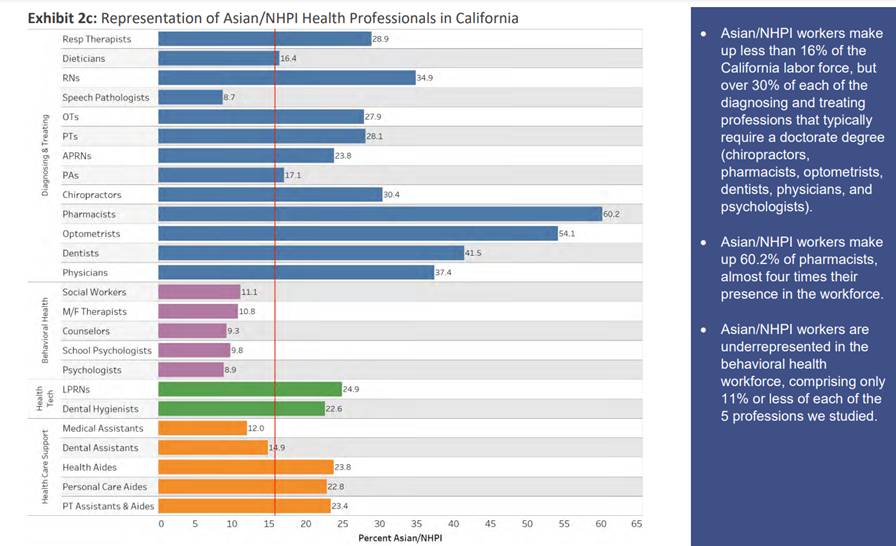

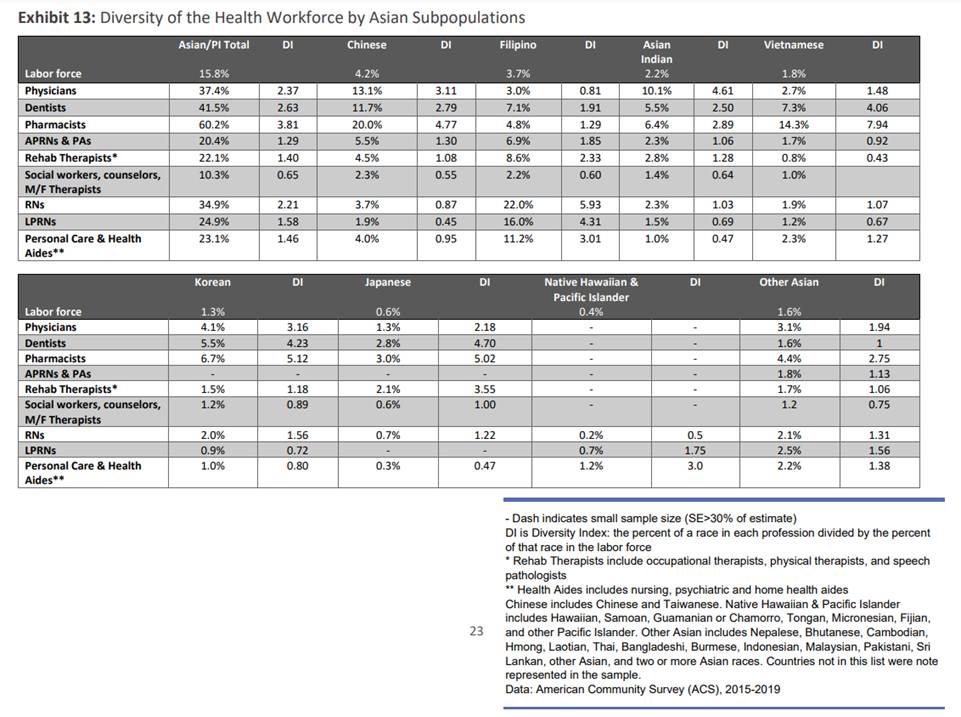
It is also critical to remember that broad data often masks the underrepresentation of Native Hawaiian, Pacific Islander, and certain Southeast Asian communities in key healthcare roles. These numbers give us a clearer picture of the environment AANHPI leaders are working in.
Spotlight on California Healthcare Leaders
Hearing from individuals driving, change brings these issues to life. Here are just a few profiles of notable leaders making their mark in California:

Margaret Chung, MD (1889–1959): A genuine trailblazer, Dr. Chung holds the distinction of being the first known American-born Chinese woman physician. After graduating from USC Medical School in 191610 and finishing her training, she faced significant racial and gender hurdles. When doors to medical missionary work were closed to her, she opened her own clinic in San Francisco in the 1920s, dedicating it to supporting Chinese American women and heading several departments. She was also politically engaged, notably advocating for the Navy’s WAVES program for women. Known for challenging conventions, she sometimes adopted masculine dress and the nickname “Mike”11, though she later returned to more traditional attire. Her medical practice gained wide respect, serving a largely white patient base by 194712, highlighting her broad impact before retiring after World War II.

Priya Abani: Leading AliveCor as CEO since 2019 in Mountain View, Priya brings over twenty years of executive skill to transforming cardiac care through a patient-focused, remote-first model. Drawn to AliveCor’s vision13, she has guided the expansion of the world’s largest AI-driven consumer subscription service for cardiovascular health, now serving over 1.5 million people worldwide. Her work includes moving into enterprise markets, partnering with providers and pharmaceutical companies, and spearheading the development of a comprehensive cardiology platform. Named a Top 50 Healthcare Technology CEO in 2022, Priya also holds board positions at Jacobs and TIAA.14 She’s a powerful example of leadership, highlighting both achievement and the ongoing need for greater diversity at the top.

Dr. Karandeep Singh, M.D.: Dr. Karandeep Singh is a physician-scientist at UC San Diego Health, known for working at the intersection of clinical care and innovative technology. With a background likely rooted in areas like Emergency Medicine and potentially augmented by expertise in informatics or data science, he focuses on leveraging artificial intelligence to improve healthcare delivery. His work often involves developing and evaluating AI tools aimed at enhancing clinical decision-making, predicting patient outcomes, and making healthcare systems work better for both patients and providers. He is recognized for his thoughtful approach to integrating these powerful technologies into the complex world of medicine.18
A significant milestone in Dr. Singh’s leadership journey was his appointment as the first-ever Chief Health AI Officer at UC San Diego Health, announced in late 2023. This pioneering role places him at the helm of shaping the institution’s strategy for using artificial intelligence across clinical care, research, and daily operations.17
Looking Deeper: Systemic Barriers Affecting AANHPI Healthcare
The journey for AANHPI individuals in healthcare is not just about individual careers; it is also shaped by wider systemic issues. Take reproductive health disparities, for example. Even as funding targets racial health gaps, AANHPI communities (roughly 6.0% Asian American, 0.2% NHPI of the US population) often get left out of the conversation or are grouped improperly in data collection, hiding their specific needs and challenges.20 This oversight makes it harder to address health inequities effectively.
Layered on top of this is the “bamboo ceiling.” Similar to the “glass ceiling” women face, this term describes the unique, often subtle barriers—like biases and stereotypes—that hinder the career advancement of Asian Americans into leadership positions. It has been part of the business vocabulary since at least the early 1990s21, highlighting how these obstacles can exist even without obvious discrimination.
Moving Forward: Strategies for Breaking Barriers
Dismantling the bamboo ceiling requires focused effort from both organizations and allies. Here are some key strategies:
-
- Embrace and Understand Diversity Within: It is time to move past treating the AANHPI community as a single group. This means actively breaking down employee data by specific ethnicity, using precise language instead of broad pan-ethnic labels when appropriate, and supporting Employee Resource Groups (ERGs) that reflect diverse cultural backgrounds.22 Remembering that Asia includes many distinct cultures, histories, and traditions is fundamental.
- Confront the “Model Minority” Myth Head-On: Educate your teams about how this stereotype is harmful and how it negatively impacts AANHPI individuals by minimizing challenges and support needs. Work to ensure performance reviews and promotion processes are objective and free from stereotype-driven biases. Try to share diverse AANHPI success stories that go beyond the myth.
- Intentionally Invest in Career Growth: Create mentorship and sponsorship programs specifically designed to support and elevate AANHPI talent.15 Offer leadership training that acknowledges and addresses the unique cultural or systemic hurdles they might encounter. Ensure fair access to significant projects and responsibilities that build leadership skills. Take a hard look at promotion pathways and succession planning to root out potential bias.16 Encourage networking across different ethnic groups to build bridges and understanding.


References:
- Stanford: Environmental Health and Safety. (n.d.-a). Asian Americans, Native Hawaiians, and Pacific Islander populations’ contributions to healthcare: Learn about the career journey of Stanford medicine AANHPI leaders. Asian Americans, Native Hawaiians, and Pacific Islander Populations’ Contributions to Healthcare: Learn about the Career Journey of Stanford Medicine AANHPI Leaders – Stanford Environmental Health & Safety. https://ehs.stanford.edu/event/asian-americans-native-hawaiians-and-pacific-islander-populations-contributions-to-healthcare-learn-about-the-career-journey-of-stanford-medicine-aanhpi-leaders
- New American Economy Research Fund. (2021, May 19). Asian Americans and Pacific Islander Americans on the frontlines. New American Economy Research Fund. https://research.newamericaneconomy.org/report/aapi-americans-on-the-frontlines/
- Toyama, W.-J. (2023, December 19). Addressing the AANHPI leadership gap in Healthcare. Forum Magazine. https://forummagazine.org/addressing-the-aanhpi-leadership-gap-in-healthcare/
- Seto, B. (2023, January 3). Changing the health care landscape for asian pacific americans. Permanente Medicine. https://permanente.org/changing-the-health-care-landscape-for-asian-pacific-americans/
- State of California. (2025, April 16). Race & Ethnicity of California’s Health Workforce. California Department of Healthcare Access and Information. https://hcai.ca.gov/visualizations/race-ethnicity-of-californias-health-workforce/
- Gonzalez, R. (2016, May 3). Health disparities in the API community: A discussion with API health advocates. California Pan-Ethnic Health Network. https://www.cpehn.org/about-us/blog/health-disparities-api-community-discussion-api-health-advocates/
- Ruggero, L. N. (2024, December 18). New report finds significant health, economic and education gaps within San Diego’s Asian American, Native Hawaiian and Pacific Islander community. San Diego Foundation. https://www.sdfoundation.org/news-events/sdf-news/new-report-finds-significant-health-economic-and-education-gaps-within-san-diegos-asian-american-native-hawaiian-and-pacific-islander-community/
- California Department of Public Health. (2022, July). Asian and Pacific Islander (AB 1726) data disaggregation. https://www.cdph.ca.gov/Programs/OPP/CDPH%20Document%20Library/AB1726-DataBriefADA_Compliant-FINAL.pdf
- Villafuerte, V. (2023, February 7). Asian Americans, Native Hawaiians, and Pacific Islan… Asian Americans, Native Hawaiians, an… | UCLA Fielding. https://ph.ucla.edu/news-events/news/asian-americans-native-hawaiians-and-pacific-islanders-california-experienced-rise
- Wagner, E. (2025, February 20). Dr. Margaret “mom” Chung (U.S. National Park Service). National Parks Service. https://www.nps.gov/people/dr-margaret-mom-chung.htm
- Rasmussen, Cecilia (June 24, 2001). “Chinese American Was ‘Mom’ to 1,000 Servicemen”. Los Angeles Times. Retrieved March 10, 2017.
- Rouse, Wendy L. (2022). Public faces, secret lives: a queer history of the women’s suffrage movement. New York: New York University Press. ISBN 978-1-4798-1394-0.
- Sherberb, Ellen. 2025. ‘ In Her Own Words: Priya Albani Move from Alexa to AliveCor ’. BizWomen . Retrieved April 11, 2025. https://www.bizjournals.com/bizwomen/news/mentoring-matters/2025/02/in-her-own-words-priya-abani.html.
- Abani, Priya. Home [LinkedIn Page] Retrieved April 11, 2025, from https://www.linkedin.com/in/priyaabani/
- Koons, K. (2024, August 29). Four steps to break the bamboo ceiling in the workplace. DirectEmployers Association. https://directemployers.org/2023/05/24/four-steps-to-break-the-bamboo-ceiling-in-the-workplace/
- Michael, A. V. (2025). Shattering the bamboo ceiling-shaking off the dusty thoughts. American College of Healthcare Executives. https://www.ache.org/blog/2023/shattering-the-bamboo-ceiling-shaking-off-the-dusty-thoughts
- Aquinde, L. (2023, December 12). Karandeep Singh, MD, named inaugural chief health ai officer at UC San Diego Health. UC San Diego Health. https://health.ucsd.edu/news/press-releases/2023-12-12-karandeep-singh-md-named-inaugural-chief-health-ai-officer-at-uc-san-diego-health/
- UCSD Profiles. (2025). Karandeep Singh • UCSD Profiles. Karandeep Singh | UCSD Profiles. https://profiles.ucsd.edu/karandeep.singh
- George Washington University. (2022, January). Theraceand ethnicityofthe CALIFORNIAHEALTH … www.gwhwi.org. https://www.gwhwi.org/uploads/4/3/3/5/43358451/ca_report.pdf
- Heyrana, K. J., Kaneshiro, B., Soon, R., Nguyen, B. T., & Natavio, M. F. (2023). Data equity for Asian American and Native Hawaiian and other Pacific Islander people in reproductive health research. Obstetrics & Gynecology, 142(4), 787–794. https://doi.org/10.1097/AOG.0000000000005340
- Kubota, S. (2021, March 17). What is the “bamboo ceiling”? here’s what Asian Americans want you to know. TODAY.com. https://www.today.com/tmrw/what-bamboo-ceiling-here-s-what-asian-americans-want-you-t212014
- Krogstad, J. M. (2025, May 1). Key facts about Asians in the U.S. Pew Research Center. https://www.pewresearch.org/short-reads/2021/04/29/key-facts-about-asian-americans/